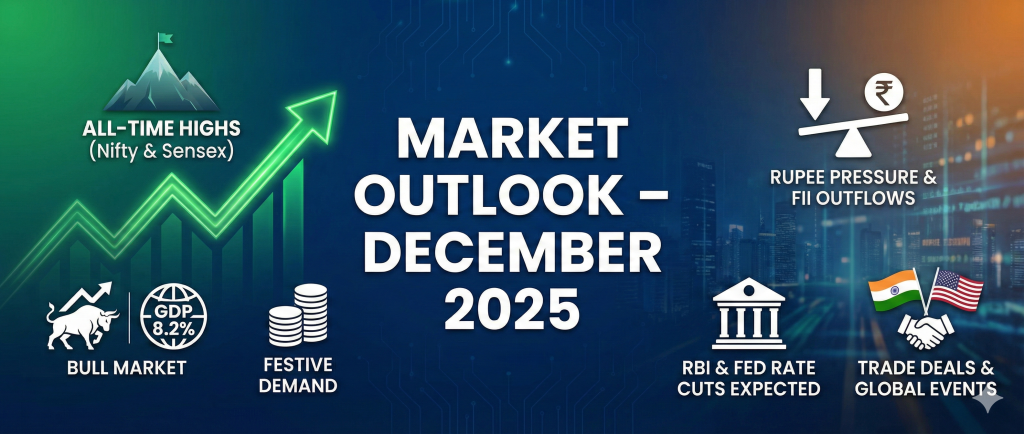
Nifty & Sensex touched all time high of 26,310 & 86,055
respectively after remaining rangebound for more than a year.
India’s economy grew 8.2% YoY in Q2 FY26, the fastest pace in six
quarters — easily beating consensus forecasts and last year’s 5.6%.
Donald Trump’s stance on tariffs toward India has become more
conciliatory. With ongoing trade negotiations and India’s recent reduction in
oil purchases from Russia, a positive announcement may be expected soon.
GST Collections – November ₹1.70 lakh crore Marginal 0.7% YoY rise, with
import GST up 10.2% but domestic GST down 2.3%. Year-to-date growth remains
strong at 8.9%.
Markets rebound in November was also aided by the resolution of the US
government shutdown, better-than-expected Q2 earnings, softer inflation, and a
strong NDA mandate in Bihar.
Oil prices remained low, trading in a range of 58-60$ per barrel.
Festive demand & GST cut boosted urban & rural consumption sales
growth. Auto Sales –2W & CV Sales were up – Avrage 30%.
Globally, financial conditions eased after the Fed’s 25 bps October cut,
with a possible additional cut in December.
Negatives in November
The rupee dropped to a fresh record low (around ₹89.49 per US dollar) in
Nov, weighed down by weak foreign investment inflows, uncertainty over global
trade deals, and broad currency pressure.
Manufacturing slump, export-linked industries hurt by tariffs &
global headwinds. India Manufacturing Purchasing Managers’ Index (PMI) fell
from 59.2 in October to 56.6 in Nov, highlighting the slowest improvement in
operating conditions since Feb.
FIIs were again net sellers in Indian Equity market with outflow of
17.5K crores.
December Key Events
RBI Monetary Policy – 5th Dec. Rate cut expected from RBI
as inflation has eased considerably. Positive for Markets.
Russian President Putin visits India – 4-5th Dec. Key defence deals expected
to be signed. Positive for Markets.
Fed Interest Rate Dec – 11th Dec, expected to cut rates by
25bps. Positive for Markets.
Investment Strategy & Asset Allocation
Nifty range 25,500-26,500; downside limited, new highs expected.
Markets expected to rise cautiously. US trade deal is the major
announcement markets are waiting for and will not make any big moves unless it
is announced.
Q3 FY26 earnings will shape market directions going ahead, expected to
be higher nos. boosting equity markets.
Globally, US economic nos. are in line. Solid Nvidia results calmed the
markets on AI bubble theory.
Japan inflation nos. needs to be tracked. With appointment of pro-rate
hike Prime Minister Sanae Takaichi, any interest rate hikes in future will push
outflow from global markets triggering global volatility.
“We don’t have to be smarter than the rest. We have to be more disciplined than the rest.”
Indian equity indices saw a further modest correction in August 2025 with BSE Sensex and NSE Nifty down 1.5%/1.2%, respectively. Broader market also continued to correct with NSE Midcap index down 2.8% and BSE Small Cap index losing 3.6% for the month.
Auto was the best performing sector as the biggest beneficiary of the GST rate cuts announced by the government. FMCG was flat for the month while all other sectors delivered negative returns for the month. IT was in-line with the Nifty while Banks, Healthcare and Capital Goods all underperformed the Nifty. Oil & Gas, Power and Real Estate were the worst performing sectors.
Global markets continued to do well. MSCI World index rose 2.5% in August led by US (S&P 500) rising 1.9%. MSCI Europe rose 3.2% and MSCI Japan rose 6.9%. MSCI EM also rose 1.2% supported by a 4.9% rise in MSCI China. Crude oil declined 6.1% in August.
FII’s remained heavy sellers in August as additional US tariffs announced on India continued to weigh on the sentiment. FIIs sold US$4.3 bn in Indian equities, although this was more than offset by DII’s investing US$10.8 bn. Domestic MFs invested US$8.1 bn while insurance inflow was US$2.8 bn.
India’s real GDP growth for Q1FY26 surprised everyone positively at 7.8% (YoY) vs 7.4% (YoY) growth in Q4FY25. This was supported by stronger growth in services while manufacturing growth also remained robust. On the Independence Day, the Prime Minister announced plans to significantly rationalize GST rates and reduce the number of slabs from 4 to 2.
RBI left key interest rates unchanged during its policy meeting in August and maintained a neutral policy stance, signalling caution amid global trade headwinds. S&P Global upgraded India’s sovereign rating from BBB- to BBB while maintaining a stable outlook.
CPI slowed to a more than 8 year low of 1.6% in July from an already very low 2.1% (YoY) in June due to continued softness in food prices. Core-core inflation (i.e. core inflation ex petrol and diesel) also moderated to 4.1% (YoY) in July from 4.6% (YoY).
Industrial production growth (IIP) improved to 3.5% (YoY) in July from a weak 1.5% (YoY)in June. Gross GST revenue collection was Rs 1.86 tn in August 2025, up only 6.5% (YoY). Other key developments during the month – On August 4, 2025, US government announced plans to impose an additional 25% import tariff on Indian goods from August 27, 2025 citing purchase of Russian crude oil, taking the overall tariff on Indian goods to 50% outside of exempted or specific categories.
Nifty consensus EPS estimate for CY25/26 saw a +1%/-1% change respectively during August as per Bloomberg. Nifty now trades on 19.8x 1-year forward PE. This is now in-line with its 5-year average and a ~10% premium to its 10-year average. Valuations in midcap and small cap space have also seen correction in the last 2 months.
GST Rate Simplification – A Landmark Reform.
India’s long-awaited GST 2.0 reform has arrived with clarity and conviction, marking a pivotal shift in the country’s indirect tax landscape. Far from being just a rate-cut exercise, GST 2.0 signals a deeper structural transformation aimed at enhancing transparency, formalisation, and consumption-led growth. The absence of negative surprises in the announcement reaffirms that policymakers are maintaining a clear focus on reviving demand and easing household financial burdens.
The sheer scale of the reform has decisively ended uncertainty around the government’s stance, with the breadth and depth of rate cuts not only meeting but, in many cases, exceeding expectations. Notably, reductions on essential goods came as a clear positive surprise, with the total consumer benefit estimated at around $20 billion—poised to inject fresh momentum into the economy. The introduction of a simplified two-slab structure—5% for essentials and 18% for most other goods and services—replaces the earlier four-tier system, while a distinct 40% rate has been earmarked for luxury and sin goods. This streamlining is expected to make the tax regime more equitable and predictable.
Market observers and policy experts view this transition as a stepping stone toward a single standard GST rate—a model adopted by several mature economies. A unified rate would eliminate classification disputes, reduce compliance burdens, and enhance transparency. With over 70% of GST collections already coming from the 18% slab, a single rate is seen as fiscally viable without significantly impacting revenue. Additionally, simplification is expected to boost formalisation, especially among MSMEs, by lowering entry barriers and reducing the incentive to operate in the informal sector. Revenue buoyancy—the responsiveness of tax revenue to economic growth—has already improved post-GST, rising from 0.72 to 1.22 for states, and a unified rate could further enhance this by broadening the tax base and reducing leakages. With monthly GST collections averaging ₹1.8 lakh crore and a tax base exceeding 1.5 crore entities, India is well-positioned to eventually converge toward a unified rate, fulfilling the long-standing vision of “One Nation, One Tax”.
Key insights from the reforms:
Simplified GST structure: Council introduces a “Simple Tax” with two main rates — 18% (standard) and 5% (merit), plus 40% for demerit goods, easing compliance and benefiting citizens and businesses.
Insurance relief: GST fully exempted on life and health insurance policies (including reinsurance), making coverage more affordable for individuals, families, and senior citizens.
Healthcare & essentials: GST on lifesaving drugs, medicines, medical devices, and supplies slashed to 0–5%, lowering treatment costs and expanding access to critical healthcare.
Everyday goods cheaper: Major rate cuts on common household items, consumer appliances, packaged foods, toiletries, bicycles, and personal care products — easing inflation pressure on consumers.
Boost to sectors: Agriculture, MSMEs, textiles, fertilizers, renewables, transport, and labour-intensive industries see rate reductions and inverted duty correction1, spurring growth, jobs, and investment. Mass mobility vehicles like smaller cars and motorcycles up to 350cc see reduced GST rates, dropping from 28% to 18%. Higher end autos have not seen cess imposition, which is a huge positive.
GDP & Inflation impact: GST related demand boost is expected to add 100 to 120 bps to the GDP growth over next 4-6 quarters, thereby nullifying the negative impact of higher tariffs on exports to US2. Staples, auto, consumer durables are likely to drive the gains. 30bps downside to CPI inflation at headline level at current basket composition is also expected. The impact will be amplified once the CPI basket changes and becomes more representable to current consumption habits.
Net revenue loss at 7bps of FY26E GDP for Centre: The total revenue loss of INR 477 bn (13 bps of FY26E GDP) is in line with the INR 500-600 bn estimated*. This shall be shared by both centre and states. The final loss is subject to buoyancy gains.
Significant push for manufacturing: The rate rationalisation aims to correct the inverted duty structure that exists in key sectors such as textiles.
Fillip to consumption: The tax rebate that came into effect this year, amid lower inflation, rate cuts along with GST cuts are likely to be positive for consumption in the economy. The impending Pay Commission awards will add further fillip.
Conclusion: The GST rate simplification is a landmark reform that combines ease of doing business with direct consumer benefit. The move is expected to:
Boost demand across key consumption categories, especially automobiles, consumer discretionary, and services.
Expand margins in sectors with lower input costs, like consumer staples, cement, and real estate.
Generate positive spillover effects for financiers and logistics.
Strengthen macroeconomic stability, with low inflation, higher growth, and no fiscal slippage.
Overall, this reform should materially improve domestic consumption and provide the much-needed push for the Indian economy, particularly ahead of the festive season.
Investment Strategy:
Nifty range 24,800-26,000; downside limited.
GST Reforms, good monsoons, Crude below 70$, lower inflation nos., rural demand pick-up, festival demand, corporate capex acceleration, consistent domestic SIP flow & valuations correction will help boost equity markets in September.
Expect markets to remain positive with possibility of markets making new highs.
“Growth comes from chaos, not order.” –
Rakesh Jhunjunwala
Equity
markets dipped in July’25 after gaining for four consecutive months, weighed
down by mixed earnings, FII outflows and uncertainty around India-US trade deal
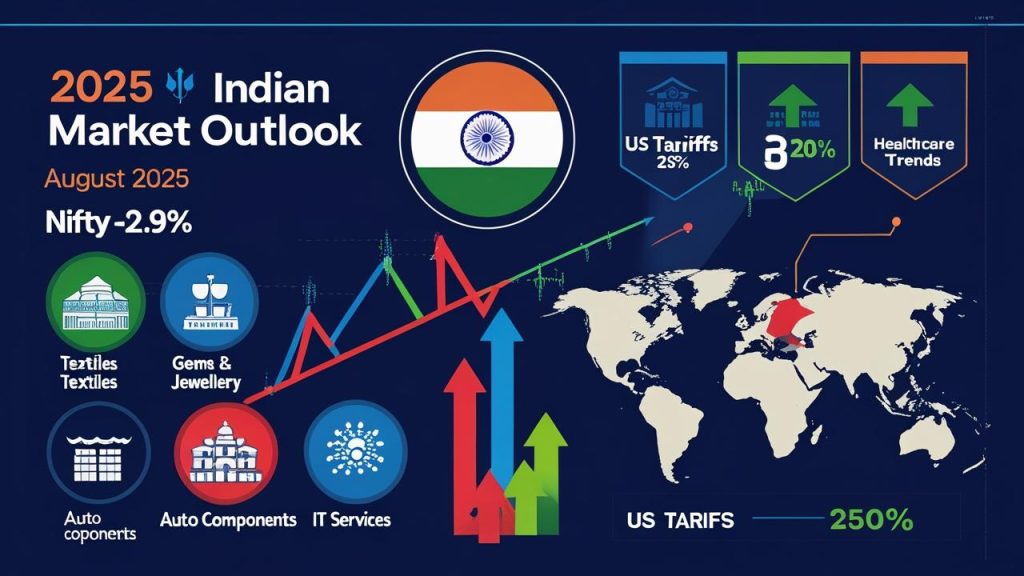
and tariffs. Nifty50 fell 2.9% (-749 points) in Jul’25, to close at 24,768.
Broader markets significantly underperformed with Midcap and Small cap Indices
declining by 2.3% each.
All
sectors ended the month with decline except healthcare. India failing to secure
a trade deal with US and slowing domestic growth weighed on sentiments. On the
contrary, all major global equity markets witnessed rally in July.
FIIs
ended their four-month buying streak, with outflows of ₹47,667 crore in
July’25, while DII inflows remained healthy at ₹60,939 crore. Weak domestic Q1
earnings dampened sentiment. Dimming hopes of the possibility of a deal between
India and US before Aug-25 and US levying 25% tariffs on India and countries
buying oil from Russia led to persistent foreign fund outflows.
Global
central banks maintained a cautious stance amid persistent inflation concerns
and mixed economic signals. The US Fed, ECB, BoJ and BoE kept rates unchanged.
RBI too held its policy rate steady, reiterating its focus on inflation control
amid resilient domestic growth.
On
the trade front, the US imposed a 25% tariff on all goods imported from India,
effective August 7, 2025. Additionally, it announced a 25% penalty linked to
India’s trade relations with Russia. These developments pose short-term
headwinds for export-oriented sectors such as IT, Pharma, Automobiles, and
Textiles, until a trade agreement is reached with the US.
Tariffs & their impact on Indian Stock Markets
Tariff Surprise: US has raised tariffs on Indian goods to over 25%, with an
additional 25% penalty linked to India’s dealings with Russia.
Limited Market Impact: Most listed Indian companies have a
predominantly domestic revenue. India’s key global sectors like Pharma and IT
remain unaffected so far. Industries with large export contribution from US
(Textiles, Gems & Jewellery) do not have significant listed presence,
although with them being large employers, second-order impact on rest of the
economy needs to be watched out for.
Watchful Optimism: Tariffs may be part of US negotiating tactics, with talks expected
to continue later this month. India can use this situation to double down on
reforms and diversify its global trade partnerships.
While
India was one of the first countries to start negotiating with US, trade talks
with US seem to have hit a roadblock owing to India’s reluctance to cede ground
on Agriculture and Dairy leading to the current impasse.
Which sectors could be impacted?
Textiles: The US is India’s biggest textile export market, making up ~50% of
India’s Textile exports. India’s export competitiveness boosted by China+1 and
instability in Bangladesh could now be offset by the new US tariff. Further,
countries like Vietnam with competitive cost of production have relatively
favourable tariff (20%) too.
Gems and Jewellery: With ~30% of its total exports going to US, steep tariff increase
could impact this sector, more so in the unlisted space. As a large employer of
labour, impact of tariff on this sector needs to be monitored.
Relief for key sectors though!!
Pharma: While US remains a key market, Pharmaceuticals remain exempt from
its newly expanded tariff regime. Given their critical role in affordable
healthcare (40% of US’s generic drug demand), Indian drugmakers are likely to
stay resilient, highlighting the sector’s key role in India-US trade.
Auto components: Auto components are already subject to 25% tariff since May’25 and
is exempt from the country-specific reciprocal tariffs. Since the levy on auto
parts is the same for all countries, there is no impact on competitiveness of
products made in India.
IT Services: India’s largest services export category remains untouched as
services have been out of purview.
No need to press the Panic Button
India’s
economy is largely domestic-driven in nature and barely 10% of NIFTY
500 companies’ revenue is driven by exports. Revenue from US is even lower.
Sectors
most impacted by US tariffs happen to be Gems & Jewellery, Leather and
Textiles which do not have large representation in the listed
space. Pharmaceuticals and Electronics remain in the exempted list.
While
US is a key export destination, India has a wide array of key trading
partners for most industries. India could aim to strengthen ties with
other economies through FTAs like the India-UK deal recently.
India
can use this crisis to double down on Aatmanirbhar
Bharat and Make in India, cutting reliance on imports in key
sectors. Reforms aimed at boosting labour
productivity and faster adoption of technology could be
imperative to make Indian manufacturing globally competitive and less
vulnerable to such events.
Going
by recent developments, the latest round of reciprocal tariff may not be cast
in stone. Deadlines have been extended multiple times earlier too.
With another round of discussion scheduled later in August, the
recent announcement could well be a bargaining tool for US.
Further, Inflationary impact of Tariffs on US economy cannot be
undermined.
Key Takeaway: While the US tariff hike presents a short-term hurdle for select
export sectors, the broader impact on India’s economy and equity market remains
limited. India’s domestic consumption-driven growth, resilient listed space,
and diversified trade ties act as strong buffers. Considering India’s
undeniable importance as a large consumer market, there is a reasonable
likelihood of a mutually beneficial deal culminating between India and US. For
investors though, this is a reminder that diversification across sectors and
asset classes is a key pillar of investing.
“Emotions are your worst enemy in the stock market.”
Nifty index
continued strength from May and witnessed renewed buying interest towards the
end where the index jumped above 25,650 zones in June. It consolidated for most
part of the month with shallow dips in between which were quickly absorbed.
All broader
indices jumped 3%. Nifty up 3.1%, Sensex 2.65%, Large Cap 3.14, Midcap 3.81%
& Small cap 3.97%. On the sectoral front we have witnessed continued buying
interest in the Financials, Infra, Auto, Private Bank, Consumption, Metal and
IT sector while fresh buying interest is witnessed in sectors like Pharma with
some weakness and short build up in FMCG space.
Foreign
Institutional Investors (FIIs) purchased shares worth INR 7,448.98 Cr., while
Domestic Institutional Investors (DIIs) acquired shares worth INR 72,673.91
Cr. On the domestic front, GST collections for the month of June stood at
INR 1.85 Lakh Cr.
The IIP growth
rate for May 2025 stood at 1.2%, down from 2.7% in April 2025. The subdued
growth was primarily due to sluggish performance in Mining and Electricity
sectors, which contracted by 0.1% and 5.8%, respectively. However, the
Manufacturing sector grew by 2.6% in May 2025.
Retail inflation
eased to 2.82% in May 2025, down from 3.16% in April 2025, as food prices
continued to soften. In the latest policy announcement, the Repo rate was cut
by 50-basis points to 5.5%, accompanied by a 100-basis point cut in the CRR.
Additionally, the policy stance was shifted back to ‘neutral’ from
‘accommodative’ all of which were unexpected moves.
On the
international front, global economic data signalled diverging trends across
regions. In the U.S., signs of a slowdown emerged as Q1 GDP contracted by 0.5%
QoQ and retail sales in May 2025 declined by 0.9% MoM, raising expectations of
early rate cuts. All eyes are now on the upcoming tariff decision by Trump,
scheduled for July 09, 2025.
Federal Reserve
kept interest rates unchanged during its June FOMC meeting. The policy stance
was neutral with the dot plot now signalling two rate cuts in 2025. The U.S.
benchmark yield eased to 4.35% in June, down 15 bps from previous month as the
expectation of rate cut has increased with some Fed Governors rooting for the
same. The Fed Chair is still on wait and watch mode as he awaits clarity on the
impact of Trump tariffs on inflation.
The markets were
buoyed by the RBI decision but corrected sharply due to the Israel Iran war.
However, the ceasefire led to bullish sentiment in the market. Although
the dampening global economic outlook could impact India’s economic growth
through weaker external demand, the domestic growth engines, viz., consumption
and investment, are relatively less susceptible to external headwinds.
Market has
recovered significantly from recent lows. Many stocks in spaces such are
defence and capital market have registered a new all-time high. A Sharp cut in
interest rates by RBI has helped as has low crude prices. Strong Q4 results vs
expectations improved sentiment. Dollar Index lower than 100, weaker USD, etc
are all positive for risk and growth assets.
Key events in
July:
US tariff deadline on 9th of July, since
most of the deals not yet done, if extended (+ve for markets) if not (-ve for
markets)
Fed Interest Rate Decision on 30th July.
Expect no change. Neutral for markets.
Quarterly results (Q1) to be declared – (Neutral to
+ve for markets)
The CROSSOVER
quarter!
As we step into
the 1QFY26 earnings season, the first six months of 2025 have proven to be one
of the most eventful periods, characterized by heightened geopolitical tensions
and international economic hostilities, culminating into both kinetic and
non-kinetic wars. This spawned not just heightened market volatility (S&P
500 VIX touching 50%+ and India VIX touching 20%+) but also a high level of
economic uncertainty and ambivalent signals for monetary policymakers,
adversely affecting corporate earnings visibility.
Despite such an
adverse backdrop for equities, the global equity markets, including India, have
shown impressive resilience in 2025, with Korea (+25% in 6M), China (+20%),
Germany (+19%), and Brazil (+19%) leading the way, while India has also
recouped 6% since Jan’25.
Investors have
chosen to look beyond the near-term geopolitical haze and focus more on
long-term market cycles. While the Indian equity market has underperformed EM
in CYTD25, it has still risen by 6% during the year, despite facing its own
geopolitical challenges and a full-scale kinetic war. Amidst the pall of
geopolitical gloom, the Indian economy is standing out for its relative
economic stability, with several macro parameters turning favourable and
corporate earnings expected to be on a progressively improving cycle going
forward.
Seasonality
Chart – Nifty 500
Over the last 10
years, July has consistently delivered the strongest returns for the NSE 500
index, with an average gain of 3.83%, making it the most reliable month for
positive market performance. This period coincides with the onset of the
monsoon season which is a critical factor for the Indian economy where over 50%
of agricultural activity depends on rainfall. A timely and well spread monsoon
boosts rural income, leading to higher consumption of goods ranging from FMCG
and two-wheelers to fertilizers and tractors.
This surge in
rural demand often acts as a tailwind for corporate earnings in several
sectors, lifting overall market sentiment. Additionally, the beginning of the
monsoon reduces uncertainty related to inflation and food prices, further
improving investor confidence. As a result, July typically benefits from a
favorable macro backdrop, making it a historically rewarding period for equity
investors in India.
Investment Strategy:
Nifty
range 24,800-26,000; downside limited.
The
market remained range-bound last week as investors awaited clarity on the
upcoming US-India trade deal and the US tariff deadline on July 9.
A
decisive breakout above the 26,000 level could pave the way for a continued
rally toward new all-time highs. Analysts suggest that investors consider using
market dips as buying opportunities.
US-India
trade deal stuck due to non-agreement in dairy & agri sector. A mini deal
may be announced soon sans dairy & agri.
Markets
in July will be expected to be highly volatile. Q1 results & Tariffs will
be the key for further direction for markets. India is still the over-valued
markets in the world. Need some strong results to win back FII flows, else
markets will remain range bound.
“You make most of your money in a bear market, you
just don’t realize it at the time.”
Markets were range-bound in May. While large-cap
stocks lagged, mid and small caps delivered strong earnings. Sectors like IT,
cement, and insurance performed well, aided by valuation comfort. Financials
consolidated, while selective profit booking amid US tariff concerns allowed
for reallocation at more attractive levels. The swift market recovery from
intra-month lows suggests strong accumulation and broad investor participation.
India’s economic momentum remained strong in FY2024–25,
with real GDP expanding by 6.5%, and Q4 (Jan–Mar 2025) posting a robust 7.4%
growth, surpassing expectations. Key sectors including construction,
manufacturing, and defence led the growth during the quarter.
India has now become the 4th largest economy globally,
marking a significant step in its global economic ascent. Projections remain
optimistic, with the country potentially becoming the 3rd largest economy by
2028.
While the Industrial Production (IIP) growth moderated to
2.7% in April 2025 (from 3.9% in March), rural demand indicators are improving.
Higher Rabi yields after four years, stable crop pricing and rising real rural
wages supported by government cash transfers and free electricity schemes in
key states have improved rural liquidity and sentiment.
The early onset of the South-West monsoon (eight days
ahead of the usual date) under neutral ENSO conditions is expected to benefit
the Kharif crop season, further boosting the rural economy.
On the global front, the US economy contracted by 0.2%
(annualized) in Q1 2025, with trade weighing heavily on growth. Additionally, a
new tax provision in former President Trump’s bill — targeting countries with
“discriminatory” tax systems — has unnerved Wall Street and may deter foreign
investment in the US. This, along with a potential dollar devaluation, could
prompt capital inflows into emerging markets like India.
Key events in June:
RBI Interest Rate Decision on 6th June. Expect
25 bps rate cut. +ive for markets.
A team of US officials expected to visit India
this month for trade talks, there is a possibility that the two countries may
agree on an interim trade pact by June 25. +ive for markets.
Fed Interest Rate Decision on 18th June. Expect
no change. Neutral for markets.
Are Small Caps Overvalued? The best thing to come
out of the exercise that the capital market regulator undertook in 2018 to
re-categorise mutual funds was standardisation. The definition of large-cap,
mid-cap and small-cap funds was standardised so that all equity funds could follow
the same definition.
Advances in the equity markets have led to an increase in
the market capitalisation of each of these groups of stocks. But the number of
these stocks in each of these baskets has remained the same.
Perhaps the time has come for the Securities and Exchange
Board of India to expand the baskets. Here’s why.
The size of the problem: As per the current rules,
here’s what a large-cap, mid-cap and small-cap stocks look like:
Large-cap: The 100 largest listed stocks by market capitalization
Mid-cap: Stocks ranked between 101 and 250 by market capitalization
Small-cap: Stocks ranked 251 and onwards by market capitalization
The Association of Mutual Funds of India has to update
this list every six months, based on data provided by the stock exchanges.
While the definitions of large-cap, mid-cap and small-cap
stocks have remained the same since 2018, the market dynamics have changed a
lot over the years.
While publishing valuation data of indexes, only top
100-250 stocks are counted in Small Cap Index, while the universe is of 5000
Stocks. This does not reflect the true value of that index and often treated as
overvalued.
India is a growing economy and most of the small cap
stocks have already become mid-caps by market capitalisation but being treated
in small category due to definition hurdle.
Expanding the basket: Given the increase of
inflows in mutual funds, it is evident that many fund managers would find the
current limit of 100 stocks for large-caps and 150 stocks for mid-caps
restrictive. Comparatively, small-cap stocks have a larger universe
beyond the 250th stock by market capitalisation.
As a result (but not only because of it), many fund
managers in active large-cap funds (and now midcap funds also) find it tough to
consistently beat their respective benchmarks. On the other hand, active
small-cap funds still have a much bigger universe of stocks at their disposal
and do much better than their benchmarks regularly.
Keep in mind how the Indian markets are growing
and more SIP money is flowing in. We don’t want to be in a situation where
we have a problem of plenty and too much money chasing a few stocks in the
large and mid-cap space.
So there may be a need to provide a bigger canvas for
large-cap and mid-cap fund managers to operate. And this can be done by
tweaking the market-cap bucketing definitions. SEBI should think on this and
widen definitions to increase number of large and mid-cap stocks.
Investment Strategy
Nifty range 23,500-25,500; downside limited.
Since COVID Govt has spent huge amount in capex,
which led to huge growth in economy. Post Trump elections & tariff
announcements, Business houses had put a pause on their expansion plans till
clarity emerges.
In last 6 months since tariff announcement,
there has been more chaos than clarity and Trump tweets & policy changes
every now & then added more fuel to the fire.
Trump 90 days waiver is ending soon and nobody
knows what will happen. Geo-political tensions between Ukraine-Russia,
Israel-Iran, India-Pakistan has escalated more than before.
Downgrade of the US credit rating by Moody’s is
increasing bond yields and making more attractive for investors to park money
in long term bonds than elsewhere.
New risk in the form of COVID has emerged. Cases
are growing as of now, but to early to press the panic button.
We expect this chaos to continue for next few
months, hence halting any business expansion plans by corporates, resulting in
lower growth. Current growth nos. are already factored in by markets and expect
to remain sideways for next few months till clarity emerges.
RBI is expected to further cut rates this year,
at least by 50 bps, hence bond yields will increase, making Debt funds
attractive. One can expect double digit growth in high secured Debt funds.
Hence allocating a 35% ratio in Debt funds this month is recommended.
Equity markets after five consecutive months of decline,
bounced back smartly in Mar’25, on the back improving domestic macros, FII
buying and short covering in F&O space.
Markets gave away much of those gains in the first week of
April,2025 as Trump tariffs kicked in creating chaos in all asset class across
world markets.
India’s retail inflation eased to seven-month low of 3.61%
in Feb’25, down from 4.31% in Jan’25. The industrial output (IIP) growth was
above expectation at 5% YoY in Jan’25 against 3.2% in December. The US
inflation fell to 2.8% in February, below January’s 3% and the market
expectation of 2.9%.
FIIs turned marginal buyers in Mar’25, ₹2,014 crore in the
secondary market– after 5 consecutive months of outflows. DII inflows remained
positive at ₹37,586 crore.
RBI Cuts Repo Rate By 25 Bps; Policy stance shifted from
‘Neutral’ to ‘Accommodative’—a positive surprise amidst ongoing uncertainty.
In the much-awaited event– US President Donald Trump
announced reciprocal tariff on imports from 185 countries on 2nd April–
escalating trade tensions and fears of an economic slowdown. US Dow fell over
9% over the next 2 days post this announcement, spiralling into a sell-off in
global equites.
But in a surprise move Trump did a turnaround yesterday and
paused the tariffs for 90 days except China, which gave world markets a
much-required relief. The Nasdaq Composite surged nearly 12%, the S&P 500
rose by 9.3%, and the Dow Jones Industrial Average increased by almost 3,000
points.
Nifty corrected by ~16% so far (till 7th April) from its
peak in the last 6 months. This correction is mainly attributed to modest
9MFY25 earnings growth (Nifty EPS grew 4% in 9M), continuous FII selling since
Oct’24 and a challenging global backdrop. While 4QFY25 is likely be another
weak quarter, expectations for FY26 earnings are still elevated and could see
downgrades, in our opinion.
Trade War: Here’s How To Think About Tariffs – and How
Not To.
1. Common but avoidable ways to interpret the situation:
a) “Tariffs will be rolled back, so it’s just a minor
nuisance.” It’s natural to think a sitting president wouldn’t hurt their
own economy and that this is merely a scare tactic. That may be true—but it may
not. The key is understanding the consequences of even a month of these
measures continuing. Equity markets won’t wait for hope to turn into reality.
Realized losses can become permanent if we panic at the wrong time. This is why
asset allocation matters deeply. Men are known to do stupid things—and men in
power, even more so.
b) “India’s tariffs are at 26% and China’s at 54%, so
we’re better off. “Not quite. Trade wars have a broad, debilitating effect on
global growth. Don’t just focus on sector-specific impacts. When global trade
slows, the hit to overall growth is significant.
c) “India’s exports to US is only 2% of India’s GDP and
therefore we are unlikely to see a large impact.” This is a suboptimal framing
of the problem. Trade wars are never bilateral. China, on which 104% tariff has
been imposed (as of 9th April) can’t export at the same prices to US, it could
dump it goods in another country where tariffs are lower. This recipient
country is likely to retaliate, and this could take shape of a multilateral,
global trade war. India’s exports are 12% to GDP and could be at risk if
countries start imposing tariffs, not just on US, but on each other as well.
d) “If we survived COVID and the 2008 GFC, we can
survive this too.” A better mindset is to prepare rather than assume
survival. Portfolios built with conservative asset allocation, diversification,
and risk control can survive any market. Otherwise, deep losses can trigger
poor behavioural responses at the worst possible time.
2. How to think about the trade war:
a) Best case: Trump reverses tariffs to pre-April 2nd levels
or announces a temporary moratorium. This would be the strongest form of damage
control and likely a short-term positive for markets.
b) Most likely case: Trump agrees to bilateral negotiations.
This opens the door to a wide range of winners and losers, potentially keeping
markets volatile and nervous.
c) Worst case: Other nations retaliate—not just against the
US, but against one another. This scenario could have a serious impact on
global and Indian growth. Markets won’t take this lightly—and with every
passing day, this outcome becomes more probable.
3. How should investors act:
a) Avoid trying to predict or forecast the future of tariffs
or the markets. Focus on exposing yourself to strategies which have a quality
bias and are valuation respecting. Since investing isn’t an exact science, use
staggered purchases. There’s no need to rush.
b) Save emotional capital in times of turmoil by reducing
the number of actions and transactions you do. High activity is an enemy of
long-term compounding.
c) Most importantly, these unknown events create bargain
opportunities in equities and other assets. Investors which have a multi-asset
or conservative approach can take benefit from these events. When investors
sell in an emotional response, the patient investors can gain from the bargains
created. Stay the course.
Investment Strategy: Nifty range 22,000-2400; with downside
limited. Tariff pause is a clear signal, worst is over. RBI rate cuts, lower
inflation, tax benefits to kick-in, good monsoon, good Q1, valuations
correction, FII buying – what other indication of a recovery does one need. So
double up your investments, such opportunities comes rarely.
Conclusion: Indian markets have corrected 16% from peak.
While large caps are now at cheaper levels, mid and small caps valuations have
become fair over long term averages. Geopolitical risks and trade tensions will
keep markets volatile in the short term, but corrections are overdone.
Therefore one should continue gradual equity investments over the next two
months, with a focus on large caps. FII buying has restarted & consistent
domestic buying is expected to drive markets higher.
“You get recessions, you had stock market declines. If you don’t understand that’s going to happen, then you’re not ready, you won’t do well in markets.” – Peter Lynch (American investor, mutual fund manager, author and philanthropist)
January 2025 Indices Summary
The year 2025 has begun with a sharp market correction. The first nine months of 2024 were highly rewarding, with mid and small caps significantly outperforming large caps. However, after reaching record highs on September 26, 2024 (Nifty 50: 26,277), the markets have since declined approximately 13%.
Large Caps: Down 15% from peak
Mid Caps: Down 21% from peak
Small Caps: Down 24% from peak
While valuations have improved post-correction in large and small caps, mid-caps remain at a premium compared to historical averages.
Key Factors Behind the Market Sell-off
Slowdown in earnings growth
Weak urban demand
Moderation in bank credit growth
Global uncertainties
Four consecutive months of FII outflows (₹87,374 crore in January 2025)
Strong DII inflows (₹86,591 crore in January 2025, marking the 18th consecutive month of net inflows)
Global equity markets displayed a mixed trend. The US, Korea, and most European markets ended in positive territory, whereas China and Japan experienced declines.
Reasons for Sharp Market Selling
1. Trump’s Tariff War: Shortly after his swearing-in, President Trump imposed tariffs on countries with high duties on US imports, triggering a global trade war. India, known for its steep import duties on US goods, will face additional tariffs from April 1, 2025. While PM Modi and Trump recently met to negotiate a resolution, India may need to lower duties or make strategic trade concessions to avoid further economic strain.
2. Elevated Valuations: Despite recent corrections, Indian markets remain overvalued compared to global peers. Heavy domestic inflows have sustained these valuations, but FIIs have taken advantage by exiting positions. Foreign Portfolio Investors (FPIs) have withdrawn approximately $17.89 billion since October 2024.
3. Fed Rate Pause & Inflation Fears: The US Federal Reserve cut rates thrice in 2024 but has since paused, waiting to assess the inflationary impact of the tariff war before making further decisions. Higher US interest rates increase borrowing costs, making Indian markets less attractive to foreign investors.4. Slowing Corporate Earnings Growth: The recent correction coincides with sluggish earnings growth. Nifty 50 reported just 4% PAT growth in 9MFY25, compared to over 20% CAGR during FY20-24. While BFSI led earnings, weakness in consumption and commodities dragged overall performance. Forward earnings revisions remain the weakest in recent tim
“Market fluctuations
are your friend, not enemy.” – Warren Buffett
Nifty index started
November on a positive note but
slipped for most part of the month and witnessed recovery towards the end. It
dropped by 1270 points from its highs with some respite towards the end and
managed to close above 24000 zones. On the sectoral front we have witnessed
buying interest in IT and Banking while weakness in Energy, Metal, Auto, FMCG
sector.
Continuous selling by
FIIs was paused due to a clean sweep
by BJP in Maharashtra assembly elections. This win means BJP & allies will
now command majority in both the houses of Parliament, leading to easy passage
of bills & continue major reforms.
Negatives in November:
Q2 GDP
shocker: Q2 GDP growth of 5.4% was at
its lowest in the last seven quarters.
India’s CPI
inflation rose to 6.21% in October,
above the RBI’s target range which may delay the rate cuts.
India’s
Manufacturing PMI fell to 56.5 in
November compared to October’s 57.5.
Q2 result
season was overall weak.
American
courts have indicted Adani for
bribing some Indian State governments of $250 million during 2021-22.
Trump ups the
ante on tariffs, vowing massive taxes
on goods from Mexico, Canada and China on Day 1.
U.S. President
Biden authorises Ukraine to use
American missiles against Russia, sparking policy shift and international
tensions.
Fed officials
adopting a cautious approach to
future interest rate cuts.
Positives in December:
BJP &
allies won Maharashtra assembly
elections with a thumping majority, paving way for clear majority in Rajya
Sabha and continuity of policy reforms.
GST collection
increased to Rs 1.82 lakh crore in
November, an 8.5% rise from the previous year.
Festive season
demand has picked up. We have the
longest marriage season (November-January), which should boost consumption.
Crude Oil
prices trading below $70 per barrel,
positive for Indian Markets.
Israel and
Lebanon accepted a US-backed proposal
to end the 13-month border conflict that spiralled into an all-out war in
September with Hezbollah.
Chinese
stimulus packages announcement below expectations, hence limiting further outflow of FII money from
India to China.
Conclusion:
Indian markets
have corrected over 8% from its peak.
Valuations were pricey as compared to peers and correction was overdue.
December is normally a month of profit booking by FIIs before year end closing,
hence further selling by them is expected.
Donald Trump
will take charge of office in January 2025 and has already announced what policy decisions will he take post
resuming office. Hence markets will wait and watch till full policy
announcements are done. A tariff war is expected to resume which is unhealthy
for world markets.
Modi Govt is
also quiet since its victory in Lok Sabha elections. Spending is slow and no major reforms announcement
has been made till now. Budget will be announced on 1st Feb 2025. New Tax Code
is expected to be announced, and other policy announcements should trigger next
leg of market upside post budget.
Benefits of
good monsoon this year will be seen in rural spending. Q3FY25, influenced by festive and wedding season
demand, likely pick up in government spending, etc. will be pivotal in shaping
the near-term growth trajectory.
Hence, we recommend
averaging in equity mutual fund schemes in coming two months. Once FIIs selling stops, domestic buying which is
consistent will take markets to new highs. We expect markets to be volatile in
December and Nifty may trade in the range of 23500 – 25000 levels.
“The big money is not
in the buying or selling, but in the waiting” – Charlie Munger
Nifty index started the September month on a positive note and
after the initial dip in the first week, it witnessed a movement of more than
1500 points to touch a fresh all time high of 26277. It remained volatile in
the last two weeks and lost all its gain of the previous month by correcting
from 26277 to 24700. It witnessed volatile swings in last five weeks, as
rallied by 1500 points followed by a sharp corrective move of more than 1600
points.
A sharp cut in key policy
rates by Fed propelled Indian equity markets to new all-time highs, while
sudden escalation in Israel-Iran war, China announcing stimulus packages, SEBI
restrictions on F&O trading and Exit polls showing BJP losing Haryana led
to sharp correction in markets.
Positives in September:
Fed slashes
interest rates by a half point, an aggressive start to its first easing
campaign in four years.
India’s Services
Sector Reached a Five-month High, With PMI Rising To 60.9 In August, Up From
60.3 In July, Driven by Strong Domestic Demand.
India Has
Overtaken China in The MSCI AC World IMI Index with A 2.35 Per Cent Weighting
Compared to A 2.24 Per Cent for The Latter.
India’s Forex
Reserves Hit All-time High Of $704.89 Billion, Up $12.5 Billion As of Sept 27.
Key reasons for heavy
selling in markets:
China’s
central bank unveils most aggressive stimulus since pandemic. In September, China unveiled a
monetary stimulus package including cuts to mortgage rates and the amount
of reserves, one is required to keep on deposit with the central bank. Those
and other measures were the most aggressive efforts so far to try to pull the
property industry out of the doldrums and spur faster growth.
Iran-Israel
Conflict: War in gulf region
escalated after Israel attacked Lebanon and killed Hezbollah chief with air
strikes. It also started a ground invasion of Lebanon, expanding the war zone
from Gaza to Lebanon. Iran in a surprise move launched ballistic missiles over
Israel to avenge the killing of Hezbollah chief which triggered a panic selling
in the market expecting an escalation of wider conflict in the region.
SEBI announces
new measures for F&O trading: In
order to protect investors’ interest and cut down on speculative trading,
capital market regulator Sebi came down heavily on the derivatives market by
announcing a series of measures. The six-step framework is designed to tackle
the surge in speculative trading volumes, especially on expiry days, while also
acting as a potential deterrent for retail investors engaging in F&O
trading.
Valuations are
at premium to historical averages:
Since valuations of all 3 broader category indexes were trading at historical
averages, correction was overdue. Above factors allowed markets to correct and
bring valuations to a little cheaper level.
Impact of
State election results: Elections
were due in states of Haryana & J&K. All exit polls predicted a loss of
BJP due to anti-incumbency factor. This also led to selling in markets as a
loss for BJP will be seen as a change in political trend – negative for
markets. Surprisingly, BJP was able to retain power for a 3rd consecutive time
in Haryana and markets took a breath of relief. Coming state elections in
Maharashtra & Jharkhand will also be keenly watched.
Conclusion: All above factors are majorly external &
geopolitical. India is still the best market in the world to invest in.
Investors should treat this correction as an opportunity rather than sell off
their portfolio.
The key factor in today’s
Indian market is the dominance of Mutual Fund investments and its ability to
cushion and support markets from the onslaught of FIIs selling. The
month-on-month inflows from retail investors in mutual fund schemes has not
stopped and continues to grow higher. Fund houses are sitting on ample cash to
be pumped in such corrections.
Big Bang IPO lined up
this month: Companies are rushing to
go public in India this year as the stock market booms, with Hyundai Motor’s
Indian unit gearing up to launch the country’s biggest initial public offering
(IPO) of 2024. Hyundai Motor India, which will be India’s largest Initial
Public Offering (IPO) till date, has fixed the price band for its public issue
between ₹1,865 to ₹1,960 per equity share.
October outlook: Large, Mid & Small Cap Indexes have corrected in
the range of 4-5% each. Large & Small Caps are in fair value zone while
Mid-Caps are still trading in over-valued zone. Q2 earnings season will start
and will play a major role in setting directions for the markets. We expect
markets to be volatile in October and Nifty may trade in the range of
24000-26000 levels.
“The Rich invest in time; the Poor invest in money.” – Warren Buffet
India’s equity markets extended their gains for the third month and ended at record highs. BSE Sensex and Nifty 50 rallied 0.76% and 1.14% on-month, respectively. Markets scaled all-time high multiple times, with the Sensex and Nifty breaching the 82,000-mark and 25,200-mark, respectively.
Strong signals of an imminent rate cut by US Fed in near future, coupled with positive US economic data, propelled the domestic equities to all-time high. Further gains in the market were capped because of sell-off in consumer and energy stocks and worries over Middle East tensions. Some losses were seen because of profit booking amid concerns over US economy, following weaker-than expected manufacturing data and rise in jobless claims.
DIIs bought Rs 482.78 billion worth Indian equities, compared with Rs 249.36 billion in Jul-24. FIIs bought Indian equities worth Rs 73.2 billion, compared with Rs 323.64 billion in Jul-24. India’s GDP growth slowed to 6.7% in Q1FY25 compared with 7.8% growth in Q4FY24. India’s GDP is estimated to grow at 6.8% in FY25.
Positives in August:
GST collections grow 10 per cent to Rs 1.75 lakh crore in August.
Monthly Mutual Fund SIP Flow crosses 23,000 Cr for first time ever.
CPI inflation dipped to 3.54% on-year in July-24 from 5.08% in June-24.
WPI Inflation eased to 2% in July’24 from a 16mth high of 3.3%.
India forex reserves touch a record high of $675 bn.
Manufacturing FDI rose 69% over the last 10Y to $165 bn in FY24.
Cumulative rainfall till 1st Sept 24 seen 7.3% above normal.
September Key Events:
Key US FED meet for a possible rate cut on Sept 17-18, 2024.
Big IPOs continues to hit market. Bajaj Housing Finance to raise 7K Cr.
War news from Israel-Iran & Russia-Ukraine. Iran’s response to Hamas leader killing is still awaited.
SEBI new ruling on F&O restrictions are expected. This can have a negative impact on the markets.
Valuations of indices are close to their 5-year averages. Domestic MFs are sitting on Rs 1.5 lakh crore or 5% of their AUM in cash, and this will further cushion any major fall.
The fundamental drivers of India’s multi-decade consumption and infrastructure growth are still firmly in place: favourable demographic dividend, rising per capita income, under-control inflation, digital transformation, strong corporate balance sheets and consolidation of Central fiscal deficit.
India’s macroeconomic situation remains strong and the budget cemented Government’s commitment to further its fiscal consolidation path. Although India’s macros look robust, valuations are not cheap. Valuations of large caps are reasonable compared to the mid and small caps.
Outlook ahead: markets are nearing an over-valued zone, corporate results have been subdued, FIIs are still selling, and DIIs are aggressive buying, all these reasons are keeping the markets afloat. We expect markets to be sideways in September and rising gradually at a slower pace than August. Disappointment in Fed September meeting can drag markets down.